
NBA Expected Value Betting: How to Calculate EV on Every Wager
 Available in US
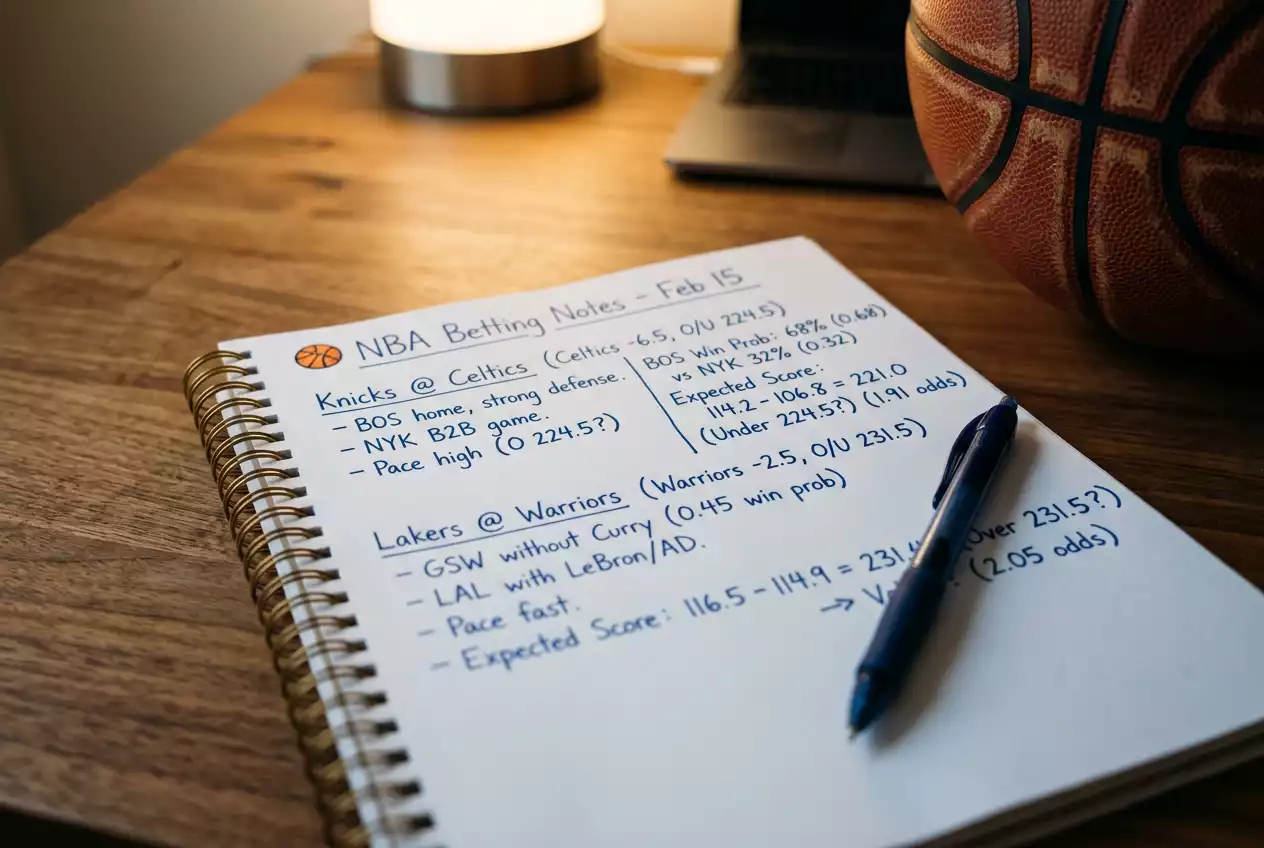
The Only Metric That Separates Winners from Losers Long-Term
Early in my betting career I had a month where I went 19-11 on NBA spread bets and still lost money. How? Because the bets I won were all priced near 1.85 while the bets I lost included several at 2.10 and above. Win rate meant nothing; what mattered was whether each individual bet had positive expected value at the time I placed it. That month was the lesson that rewired my entire approach.
Expected value — EV — is the single number that tells you whether a bet is worth making. It strips away narrative, gut feeling, and recent results. It asks one question: if I placed this exact bet a thousand times at this exact price, would I make money or lose money? Every professional bettor I respect builds their process around this concept, and it is the foundation that separates long-term winners from punters who break even or worse.
Over the last five seasons, NBA favourites have won 67.98% of regular-season games outright. That number is public knowledge. But whether backing a specific favourite at a specific price carries positive EV depends entirely on the relationship between the true probability and the implied probability embedded in the odds. Knowing the win rate is table stakes; converting it into an EV calculation is where the edge lives.
The EV Formula and How to Apply It to Decimal Odds
The formula itself is simple enough to fit on a napkin: EV = (probability of winning * profit if you win) – (probability of losing * stake lost). That is it. No advanced maths, no calculus, no Greek letters. The difficulty is not the formula — it is estimating the true probability accurately enough for the calculation to be useful.
In decimal odds, the calculation is even cleaner. If you estimate a team has a 55% chance of covering the spread and the decimal odds are 1.95, here is the maths: EV = (0.55 * 0.95) – (0.45 * 1.00) = 0.5225 – 0.45 = +0.0725. That positive number means you expect to profit 7.25 pence per pound staked over the long run. Any bet with a positive EV is worth taking; any bet with a negative EV is a donation to the bookmaker.
The formula requires two inputs: the true probability and the odds. The odds are visible on your screen. The true probability is your estimate — your model’s output, your assessment, your informed opinion. The entire game of sports betting reduces to one question: is your probability estimate more accurate than the bookmaker’s implied probability? If yes, you have positive EV. If no, you do not.
Three Worked Examples: Spread, Moneyline and Prop
Let me walk through three real-world scenarios I have encountered, with the numbers changed slightly to keep things clean.
Spread example: your model gives team A a 54% chance of covering -4.5. The bookmaker offers 1.91. EV = (0.54 * 0.91) – (0.46 * 1.00) = 0.4914 – 0.46 = +0.0314. Positive EV of 3.14% per unit. That is a bet worth making. Note that 54% does not sound impressive — you lose nearly half the time — but at 1.91, that edge compounds over hundreds of bets.
Moneyline example: you estimate a home underdog has a 38% chance of winning outright. The bookmaker offers 2.75. EV = (0.38 * 1.75) – (0.62 * 1.00) = 0.665 – 0.62 = +0.045. Positive EV of 4.5%. NBA underdogs win outright 32.02% across the last five seasons, but in this specific spot — perhaps a home underdog in a look-ahead game — your 38% estimate reflects situational factors the base rate does not. That is where the value sits.
Prop example: you project a player to score 23 points based on usage, pace and matchup. The bookmaker sets his points line at 20.5, with the over priced at 1.80. You estimate the probability of him exceeding 20.5 at 62%. EV = (0.62 * 0.80) – (0.38 * 1.00) = 0.496 – 0.38 = +0.116. That is a strong 11.6% edge, and it reflects the kind of inefficiency that exists in player-prop markets where the bookmaker is pricing off a model that may not account for tonight’s specific defensive matchup.
Where to Find Positive EV in NBA Markets
The honest answer is that positive EV is harder to find in the NBA than in less liquid sports. The main US market attracts sharp money that compresses inefficiencies quickly, and UK-licensed bookmakers price off those efficient lines. But “harder” is not “impossible,” and the edges tend to cluster in specific areas.
Player props are the most consistently mispriced NBA market for UK bettors. The sheer volume of props — dozens per game, across multiple statistical categories — means bookmakers rely on automated models that do not always capture game-specific context. A starting centre in foul trouble, a point guard facing a bottom-five perimeter defence, a wing playing his first game back from a minor injury and likely on a minutes restriction — these situations create divergences between the model’s projection and the real probability.
Early-week lines on lower-profile games offer another window. The NBA’s biggest games — nationally televised, marquee matchups — attract the most sharp action and settle into efficient prices quickly. Tuesday and Wednesday games between mid-table teams receive less attention, and the opening lines sometimes sit uncorrected for hours. If your model identifies value on these games early in the week, you can often lock in a price that will have moved by tip-off.
The NBA’s own EVP Dan Spillane emphasised in his 2026 letter to the CFTC that official league data should be required for settling sports contracts, which reflects the league’s awareness that data quality affects market integrity. For EV bettors, this matters because the accuracy of your probability estimates depends on the quality of the data feeding your model. Use the best available sources — official box scores, advanced stats databases, injury reports direct from the league — and your EV calculations will be built on firmer ground.
Finding positive EV is a process, not an event. I run my model every morning, flag the games where my numbers diverge from the market by more than 3%, then confirm the divergence makes sense before placing anything. Most days I find one or two bets that qualify. Some days I find none. The discipline to bet only when the EV is genuinely positive is what separates this approach from bankroll management as a concept and turns it into a practical system.
What does positive expected value mean in NBA betting?
Positive expected value means that a bet, if placed repeatedly at the same odds and with the same true probability, would produce a profit over time. It is calculated by comparing your estimated probability of winning with the implied probability embedded in the odds. A bet has positive EV when your estimated win probability exceeds the break-even probability implied by the price.
Can recreational bettors realistically find positive EV NBA wagers?
Yes, but it requires work. The main spread market is efficient and hard to beat consistently without a quantitative model. Player props, early-week lines on lower-profile games, and situational spots such as back-to-backs or injury-adjusted matchups offer more frequent mispricing. Recreational bettors who focus on a narrow niche and track results over meaningful samples can identify and exploit positive EV opportunities.
Prepared by the Betting Tips nba editorial staff.