AI and Machine Learning in NBA Betting: Hype, Reality and Practical Use
 Available in US
Every Tout Claims an AI Model — Most Are Just Spreadsheets
Last season a tipster on social media marketed his picks as “powered by proprietary AI” and charged 50 pounds a month for access. Out of curiosity I subscribed for one month and reverse-engineered his selections. They were basic regression outputs — the kind of model you can build in an afternoon with free NBA data and a spreadsheet plugin. There was no neural network, no deep learning, no natural-language processing. There was a linear regression with five inputs and a marketing budget. The label “AI” was doing more work than the model.
I am not saying artificial intelligence has no role in NBA betting. I am saying the gap between what is marketed as AI and what actually uses machine learning in a meaningful way is enormous. Online platforms now handle about 75% of all global betting revenue, with mobile apps driving 78% of that activity. The data infrastructure exists for sophisticated modelling. But the sophistication is concentrated in the hands of a few quantitative firms and the bookmakers themselves — not in the 30-pound-a-month Discord channel promising “AI-generated picks.”
This article is for the hobbyist who wants to understand what machine learning can realistically contribute to their NBA betting process, and where the hype outstrips the substance.
Where Machine Learning Adds Value in NBA Prediction
Machine learning excels at pattern recognition across large datasets — finding nonlinear relationships that traditional regression misses. In NBA betting, this translates to a handful of specific applications that are genuinely useful.
Player-prop projections are the clearest win. A machine-learning model can ingest a player’s game logs, matchup data, pace context, minutes patterns and usage trends, then output a probability distribution for his scoring, rebounds or assists in tonight’s game. The model handles interactions between variables — the way a player’s scoring changes when his usage increases against a specific defensive scheme — that a linear model cannot capture. In the 2025-26 season, three-point shooting and team pace remain the key inputs for line-setting, and an ML model trained on these features can outperform the simpler models most bookmakers use for prop pricing.
Injury-impact modelling is another productive application. When a key player is ruled out, the redistribution of minutes and usage across the remaining roster is complex and context-dependent. A machine-learning model trained on historical absence data can project how a team’s offensive and defensive efficiency changes with specific combinations of available players, producing more accurate spread and total adjustments than the bookmaker’s blanket formula.
In-play prediction is the frontier. The volume of real-time data generated during an NBA game — shot locations, player tracking, possession outcomes — is enormous, and machine-learning models can process it faster than human judgment. But accessing this data in real time requires infrastructure that most hobbyists do not have, which limits the practical value of ML for live betting outside of professional operations.
Why AI Cannot Replace Human Judgment in Betting
The NBA’s own EVP Dan Spillane emphasised in his 2026 CFTC letter that official league data should be required for settling sports contracts. That insistence on data quality highlights a fundamental limitation of any model, AI-powered or otherwise: the output is only as good as the input. Machine-learning models trained on noisy, incomplete or biased data will produce noisy, incomplete and biased predictions — just faster and with more mathematical confidence than a human analyst.
Context is where AI falls short most visibly. A model can tell you that a team’s fourth-quarter performance declines on back-to-backs, but it cannot tell you that the coach has been experimenting with a new closing lineup this week, or that a player’s body language in warm-ups suggested a minor issue that is not on the injury report. These qualitative inputs require human observation, and they matter enormously in specific games even if they are irrelevant in aggregate.
Overfitting is the technical trap. A sufficiently complex ML model can fit historical NBA data almost perfectly, producing impressive-looking backtests that collapse on new data. The NBA changes every season — rule modifications, roster turnover, coaching hires, style evolution — and a model trained on the 2022-23 season may not generalise to 2025-26. Regular retraining, conservative complexity and ruthless out-of-sample testing are the guardrails, and most hobbyists skip them because they are tedious.
Practical Tools for Hobbyist NBA Bettors in the UK
If you want to incorporate machine learning into your NBA process without quitting your job, here is what I recommend. Start with a spreadsheet-based model using the six core variables I outlined in my model-building guide: offensive efficiency, defensive efficiency, pace, home-away, rest days and opponent strength. Run this for a full season and verify it adds value against the closing line.
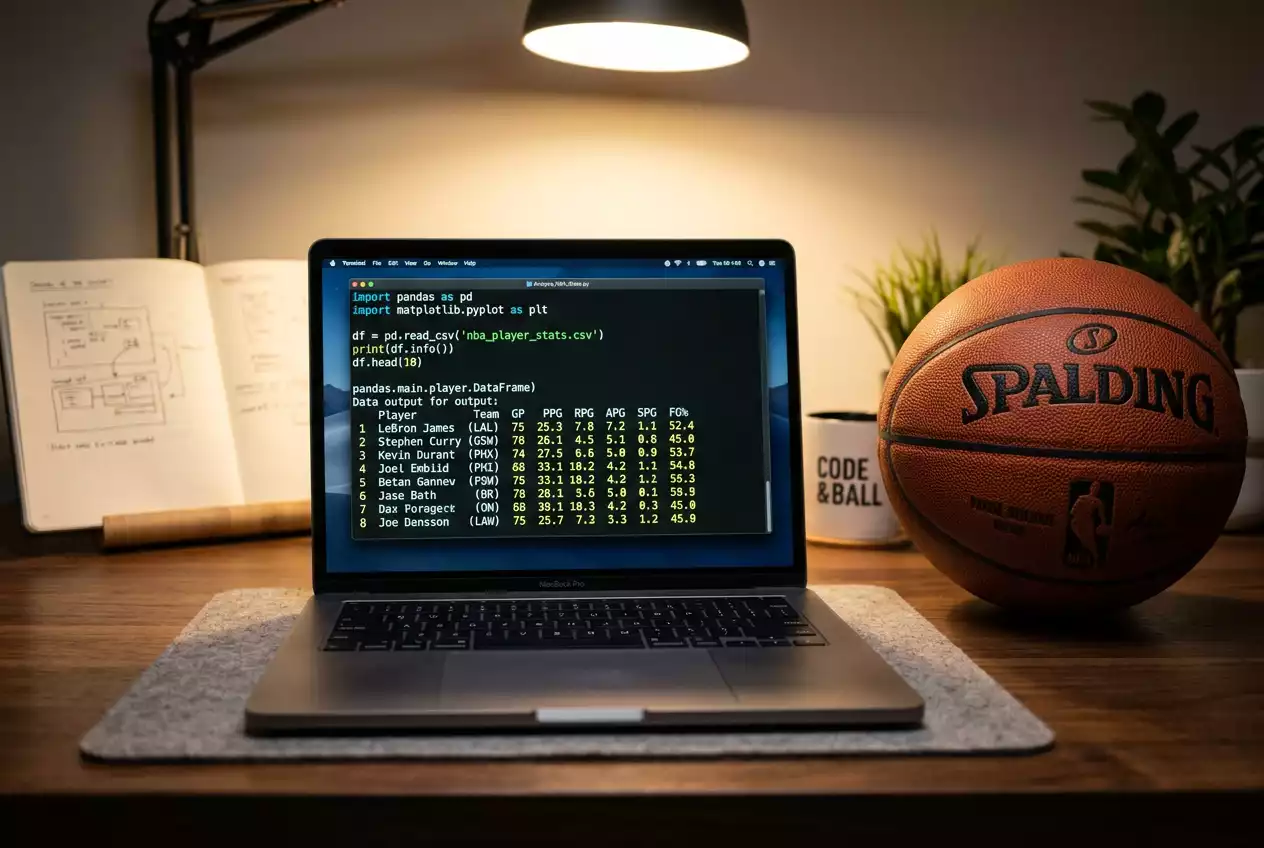
Once you have a baseline, you can experiment with free ML tools. Python libraries for machine learning are accessible to anyone with basic coding skills, and the NBA’s public data APIs provide the inputs you need. A random-forest model — one of the simplest ML algorithms — trained on five seasons of team-level data can produce spread and total projections in minutes. The key is to keep the model simple, test it on data it has never seen, and treat its output as one input alongside your human analysis rather than as an oracle.
Television still accounts for 52.19% of NBA engagement, and social media and apps are growing at 8.37% annually. The data ecosystem surrounding the NBA will only deepen, which means the tools available to hobbyists will improve. But the fundamental challenge will remain: the bookmaker has more data, better models and faster infrastructure than you do. Your edge as a hobbyist comes not from out-computing the bookmaker but from combining a decent model with human judgment, niche focus and disciplined execution. AI is a tool in that process, not a replacement for it.
Can AI and machine learning improve NBA betting results?
Yes, in specific applications. Machine-learning models add the most value in player-prop projections and injury-impact modelling, where they can capture nonlinear relationships that simpler models miss. However, the improvement is incremental rather than transformative, and it requires clean data, careful testing and regular retraining. AI is a tool that enhances a disciplined process, not a shortcut that replaces one.
What data do I need to train an NBA prediction model?
At minimum, you need team-level offensive and defensive efficiency, pace, home-away status, rest days and opponent-strength ratings. This data is freely available from the NBA’s official stats portal. For player-prop models, add individual game logs, usage rates, minutes data and matchup-level defensive statistics. Five seasons of historical data provides a sufficient training set for a team-level model.
Published by the Betting Tips nba team.