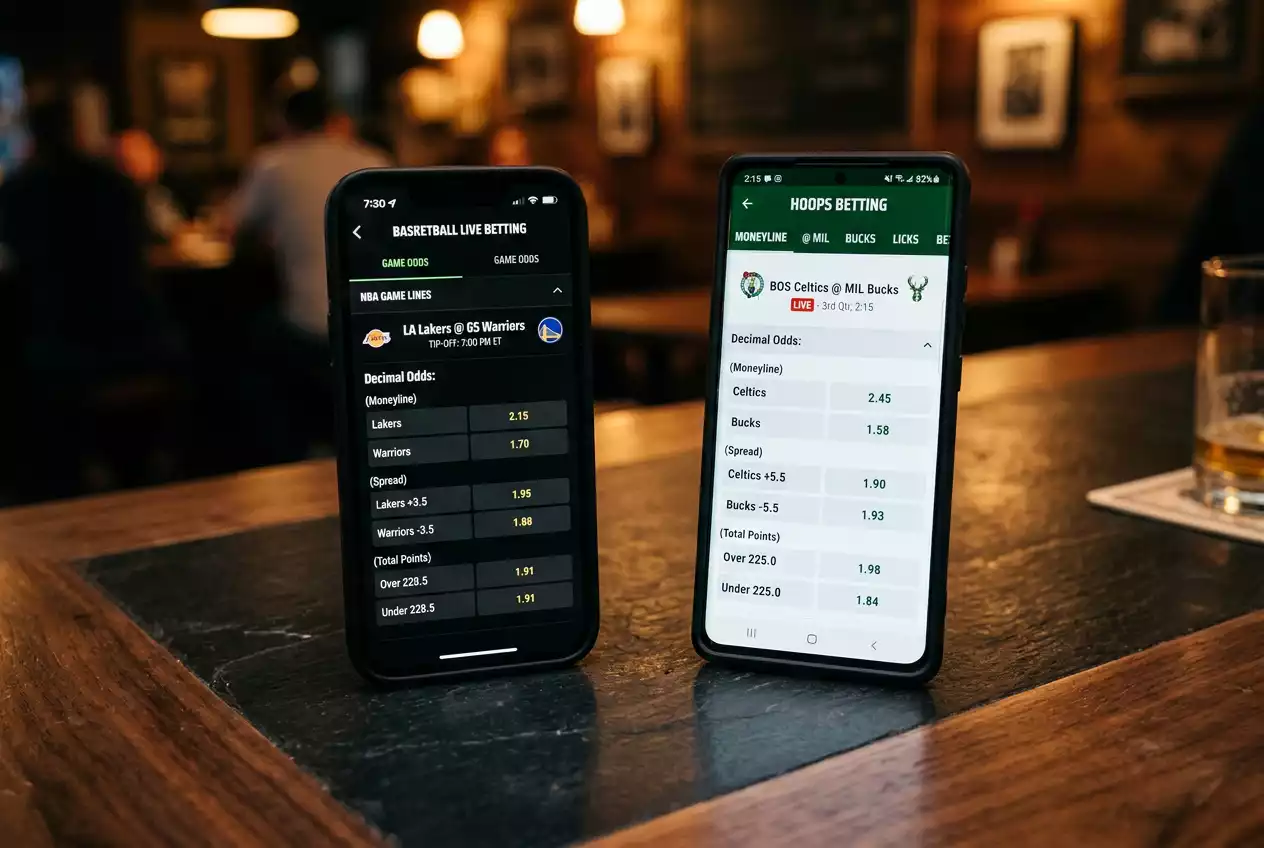
NBA Decimal Odds Conversion for UK Bettors
 Available in US

Odds Format Differences: UK Bookmakers vs US Markets
The first time I tried following an American NBA tipster’s picks, I spent twenty minutes trying to figure out what “-110” meant. He was quoting American odds — the default format in the US market — and I was sitting in front of a UK bookmaker showing me 1.91. Same bet, same price, completely different language. If you have ever felt confused staring at a US betting podcast’s recommendations and wondering how to translate them into the numbers on your screen, this guide will sort that out permanently.
The UK defaults to decimal odds, and for good reason: they are the most intuitive format for calculating returns. Roughly 10% of UK adults participate in online sports betting, and the vast majority of them encounter decimal format from day one. But NBA content is overwhelmingly produced in the US, where American odds dominate. If you consume any English-language NBA analysis — podcasts, Twitter threads, analytics sites — you need fluency in both formats to extract value from that content.
The format difference is not just cosmetic. It affects how you mentally process probability, how quickly you compare lines across operators, and how easily you spot value. Decimal odds make implied probability calculation trivial, which is why I prefer them even when discussing odds with US-based colleagues.
Decimal, Fractional and American: Three Formats for One Price
Think of odds formats like temperature scales. Celsius, Fahrenheit and Kelvin all describe the same heat — they just use different numbers. A bet priced at 1.91 in decimal is the same as 10/11 in fractional and -110 in American. The underlying probability and payout are identical; only the notation changes.
Decimal odds represent the total return per unit staked, including your original stake. If you bet 10 pounds at 1.91, your total return on a win is 19.10 — your 10-pound stake plus 9.10 profit. That simplicity is the format’s strength. You multiply your stake by the odds and you have your total return. No extra steps, no mental gymnastics.
Fractional odds — 10/11, 5/2, 7/4 — tell you the profit relative to your stake. A 10/11 bet returns 10 pounds profit for every 11 staked. These were standard in UK betting shops for decades, but most online operators now default to decimal because it handles complex prices more cleanly. You will still encounter fractional odds on older platforms and in horse racing, but for NBA betting, decimal is the working language.
American odds split into positive and negative. Negative odds like -110 tell you how much you must stake to win 100 units of currency. Positive odds like +150 tell you how much profit you earn on a 100-unit stake. The format is designed around a $100 base unit, which makes it intuitive for Americans but needlessly confusing for everyone else. When you see an NBA line quoted as -110/+100, your job is to convert those to decimal so you can compare with what your UK bookmaker is offering.
How to Convert Between Odds Formats Step by Step
I do these conversions so often they are automatic now, but I remember the early days of scribbling formulas on sticky notes next to my monitor. Here are the three conversions you will use most, laid out as simply as I can manage.
American to decimal for negative odds: divide 100 by the absolute value of the American odds, then add 1. So -110 becomes (100 / 110) + 1 = 1.909, which rounds to 1.91. For positive American odds: divide the American odds by 100, then add 1. So +150 becomes (150 / 100) + 1 = 2.50.
Fractional to decimal: divide the first number by the second, then add 1. So 5/2 becomes (5 / 2) + 1 = 3.50. And 10/11 becomes (10 / 11) + 1 = 1.909.
Decimal to American: if the decimal odds are 2.00 or higher, multiply (decimal – 1) by 100 to get the positive American odds. So 2.50 becomes (2.50 – 1) * 100 = +150. If the decimal odds are below 2.00, divide -100 by (decimal – 1). So 1.91 becomes -100 / (1.91 – 1) = -109.9, rounded to -110.
You do not need to memorise these. Most UK bookmakers let you toggle between formats in your account settings, and free conversion tools are everywhere online. But understanding the logic means you can sanity-check any number you encounter and never misread a line when consuming US-produced NBA content.
Calculating Implied Probability and Overround
This is where decimal odds become genuinely powerful, and it is the concept that moved me from recreational bettor to something approaching systematic. Every set of odds implies a probability — the bookmaker’s estimate of how likely each outcome is, with their margin built in. In decimal format, the implied probability is simply 1 divided by the odds.
Take a spread market priced at 1.91 on each side. The implied probability for each outcome is 1 / 1.91 = 52.36%. Add the two sides together: 52.36% + 52.36% = 104.72%. That total exceeds 100% by 4.72 percentage points — the overround, also called the vig or juice. The overround is the bookmaker’s built-in margin, and it is the tax you pay on every bet.
Knowing the overround lets you compare bookmakers objectively. If one operator prices a spread at 1.91/1.91 (4.72% overround) and another at 1.93/1.93 (3.63% overround), the second is offering a fairer price. Over hundreds of bets, that difference compounds into real money. NBA favourites win outright 67.98% of the time over the last five seasons, but the implied probabilities baked into the odds almost always sum to more than 100%. Your job is to find spots where the true probability sits above the implied probability for one side, after accounting for the overround.
The overround varies by market type, and this is where NBA bettors in the UK should pay attention. Main spread and moneyline markets typically carry overrounds between 4% and 6% at UK-licensed operators. Player-prop markets, where the bookmaker’s model is less refined, often carry overrounds of 8% or higher. That wider margin means you need a bigger edge on props to break even, but the mispricing is also more frequent — a trade-off that defines where opportunity sits. When I first started tracking overrounds across operators, I was surprised how much they varied on the same game. Checking this number before placing a bet is now an automatic part of my process.
For a practical walkthrough of how to use implied probability to identify positive expected value, I have a separate guide on how NBA spreads work that builds on these foundations.
What do decimal odds of 1.50 mean for an NBA bet?
Decimal odds of 1.50 mean that for every pound you stake, your total return on a win is 1.50 pounds — your original stake plus 0.50 profit. The implied probability is 1 / 1.50 = 66.67%, meaning the bookmaker considers the outcome roughly a two-in-three chance after building in their margin.
How do I calculate the bookmaker’s margin from decimal NBA odds?
Convert each side’s decimal odds to implied probability by dividing 1 by the odds. Add all implied probabilities together. The amount by which the total exceeds 100% is the bookmaker’s overround or margin. For example, a market priced at 1.91 on both sides has implied probabilities of 52.36% each, totalling 104.72% — a 4.72% margin.
Published by the Betting Tips nba team.